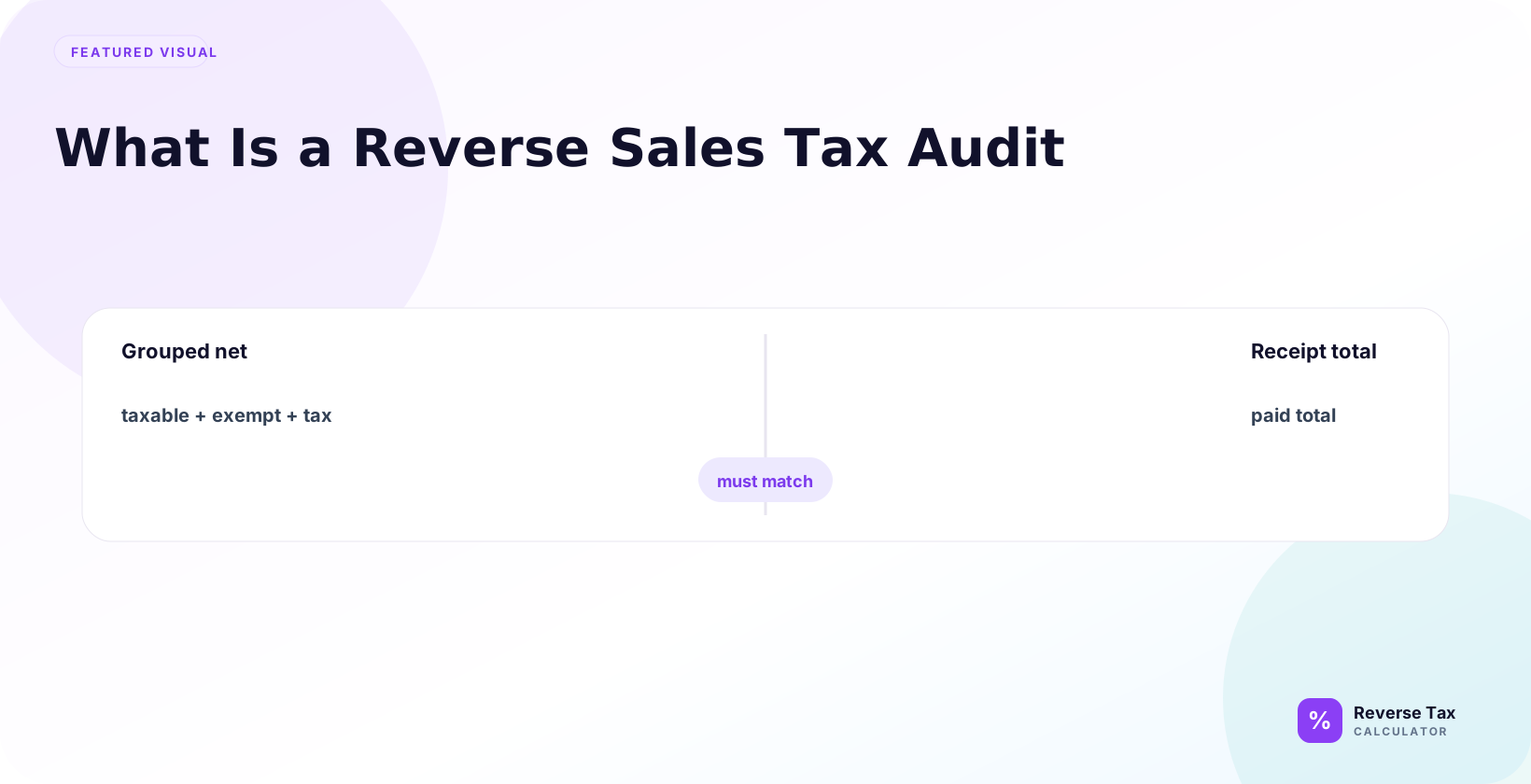
A reverse sales tax audit checks whether tax-inclusive sales were separated correctly into net sales and sales tax collected. The audit compares receipt totals, tax rates, taxable subtotals, refunds, discounts, and accounting entries to find differences caused by wrong rates or mixed taxability. Audit results depend on jurisdiction rules, source documents, marketplace collection, exempt sales, local taxes, rounding, and whether historical rate changes were applied.
It is called reverse because the review often starts with the final customer total or collected tax amount, then reconstructs the pre-tax sale and compares it with records.
What Is a Reverse Sales Tax Audit?
A reverse sales tax audit reviews gross receipts, invoices, receipts, reports, and tax calculations to identify whether collected tax, taxable sales, rates, and exemptions were handled correctly. It works backward from totals and records to find calculation differences and their causes.
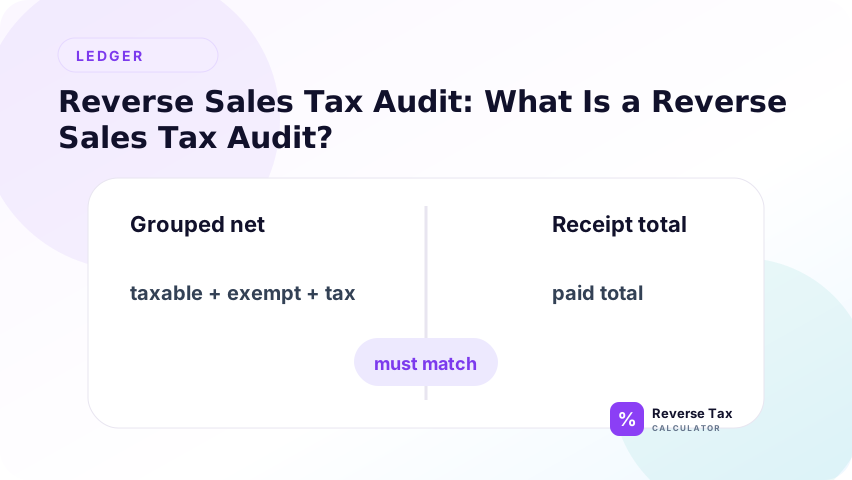
A reverse sales tax audit checks whether sales tax was calculated, collected, recorded, and remitted correctly by backing tax out of totals and comparing the result with source records.
It can reveal:
- Overcollected tax
- Undercollected tax
- Wrong taxable base
- Wrong rate
- Misclassified exempt sales
- Marketplace facilitator issues
- Sales Tax Payable mismatches
How Is It Different from a Regular Sales Tax Audit?
A formal sales tax audit is performed by a tax authority or handled in response to an official inquiry. A reverse sales tax audit is usually internal. It helps a business find issues before filing, before closing books, or before responding to a notice.
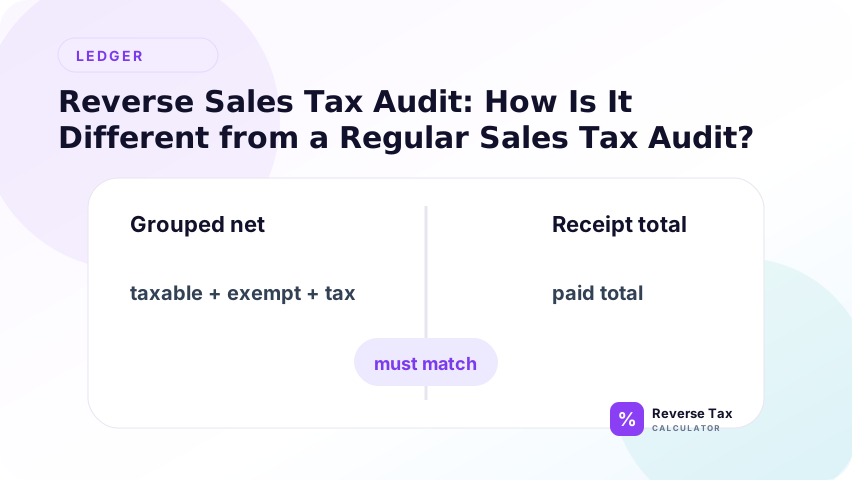
The internal audit may use similar evidence, but it does not replace official rules or professional representation.
Why Would a Business Run a Reverse Sales Tax Audit?
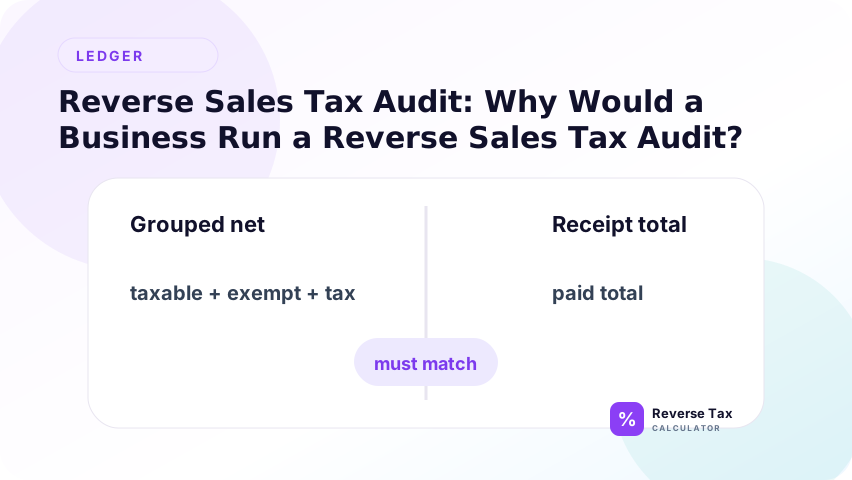
Businesses run reverse audits when records are messy, tax-inclusive totals were posted, rates changed, marketplace sales were mixed with direct sales, or Sales Tax Payable does not reconcile.
Common triggers include:
| Trigger | Why it matters |
|---|---|
| Gross receipts include tax | Revenue and tax need splitting |
| Payable balance looks wrong | Liability may be overstated or understated |
| Marketplace sales grew | Remittance responsibility may differ |
| New locations opened | Rate mapping risk increases |
| Refunds are frequent | Tax reversals may be missed |
| Exempt customers exist | Certificate support may be needed |
What Records Are Used?
A reverse sales tax audit should use source records, not memory.
Key records include:
- Receipts
- Invoices
- Point-of-sale exports
- Tax reports
- Refund reports
- Marketplace statements
- Bank deposits
- General ledger
- Sales Tax Payable detail
- Exemption certificates
- Rate lookup notes
IRS Publication 583 discusses keeping business records that support income, deductions, and credits. For a sales tax review, records should support sales, tax collected, adjustments, and payments.
What Formula Is Used in a Reverse Sales Tax Audit?
The common formula is tax-inclusive total divided by 1 plus the tax rate to find the before-tax amount. Audits may also use implied rate formulas, shown tax subtraction, and group-level calculations. The formula depends on which values the records provide.
For tax-inclusive totals:
Pre-tax sale = Total divided by (1 plus tax rate)
Tax = Total minus pre-tax sale
For known tax amount:
Taxable base = Tax amount divided by tax rate
For implied rate:
Implied rate = Tax amount divided by taxable base
These formulas show whether the numbers are mathematically consistent.
Example: Backing Tax Out of Gross Receipts
If gross taxable receipts are $10,800 and the rate is 8%, the backed-out taxable sales amount is $10,000 and the included tax is $800. This example works only when the gross amount is a clean tax-inclusive taxable total.
Gross receipts including tax: $21,600.00
Rate: 8%
Pre-tax taxable sales = $21,600.00 divided by 1.08 = $20,000.00
Tax collected = $1,600.00
Audit question: does the ledger show $20,000.00 revenue and $1,600.00 Sales Tax Payable, or was the full $21,600.00 posted as revenue?
Example: Finding the Implied Rate
If subtotal and total are known, the implied rate is total minus subtotal divided by subtotal. This can reveal whether the transaction used the expected rate. If the implied rate looks strange, review local rates, mixed items, discounts, and rounding before assuming an error.
Invoice taxable base: $500.00
Tax charged: $42.50
Implied rate = $42.50 divided by $500.00 = 8.5%
Audit question: was 8.5% the correct rate for the invoice date, location, and item category?
How Do You Run a Reverse Sales Tax Audit?
Use a repeatable workflow.
| Step | Action | Result |
|---|---|---|
| 1 | Define audit period | Scope |
| 2 | Pull sales and tax reports | Source data |
| 3 | Group by jurisdiction and rate | Clean calculation |
| 4 | Reverse tax from tax-inclusive totals | Tax and sales split |
| 5 | Test implied rates | Rate validation |
| 6 | Review exempt sales | Support check |
| 7 | Review refunds and credits | Adjustment check |
| 8 | Compare payable and remittances | Liability check |
| 9 | Document exceptions | Action list |
What Is Overcollected Sales Tax?
Overcollected tax means the customer was charged more tax than the correct calculation supports. This can happen from wrong rates, taxable flags on exempt items, taxed shipping that should not have been taxed, or service charges misclassified as taxable.
Overcollection is not free revenue. Many jurisdictions have rules about refunding customers or remitting overcollected tax. Verify official rules before adjusting.
What Is Undercollected Sales Tax?
Undercollected sales tax means the tax collected appears lower than expected for the taxable base and applicable rate. It can come from wrong rates, exempt items treated incorrectly, missing local tax, discounts, or system setup errors. It should be investigated with source records.
Undercollected tax means the seller charged less tax than the correct calculation supports. This can happen from missing local rates, exempt flags on taxable items, discounts handled incorrectly, or marketplace settings mapped to the wrong jurisdiction.
Undercollection can create liability even if the customer was not charged enough.
How Does a Reverse Audit Find Wrong Taxable Bases?
A reverse audit compares tax lines against taxable bases. If tax was calculated on too small or too large a base, the rebuilt total will not match the source record. This often reveals discount, shipping, exemption, or product-category setup problems.
A wrong taxable base often appears when the implied rate looks unusual.
Example:
Subtotal: $1,000.00
Tax: $40.00
Expected rate: 8%
Implied taxable base = $40.00 divided by 0.08 = $500.00
Audit question: why was only $500.00 taxable? Possible answers include exempt items, resale certificate, bundled products, partial refund, or system error.
How Does a Reverse Audit Find Wrong Rates?
A reverse audit finds wrong rates by comparing expected rates, implied rates, and shown tax amounts. Differences may indicate missing local rates, outdated rates, wrong tax category, or cross-jurisdiction setup issues. Rate findings should be supported by transaction-date evidence.
If the taxable base is reliable, divide tax by base.
Example:
Taxable base: $750.00
Tax charged: $56.25
Implied rate: 7.5%
Expected rate: 8.25%
This suggests a rate mapping issue unless another rule explains the difference.
How Do Marketplace Sales Affect the Audit?
Marketplace sales affect the audit because marketplaces may collect and remit tax separately from the seller. The audit should distinguish seller-collected tax, marketplace-collected tax, marketplace fees, payouts, and order totals so tax is not double-counted. The audit question is not only whether tax was charged. It is also who controlled the tax line and who had remittance responsibility.
Marketplace sales can show tax collected from the buyer even when the marketplace is responsible for remitting it.
A reverse audit should separate:
Seller-Collected Tax
Seller-collected tax is tax the seller charged or controlled and may need to remit. In a reverse audit, this amount should be tested against taxable sales, rates, refund adjustments, and the seller's payable account. The workpaper should show the source report proving that the seller, not the marketplace, was the collector. Without that distinction, overcollection and undercollection conclusions can be assigned to the wrong party.
Marketplace-Collected Tax
Marketplace-collected tax is tax the marketplace collected under marketplace facilitator or similar rules. The seller may still see the tax in order reports, but that visibility does not automatically mean the seller owes it. A reverse sales tax audit should trace marketplace-collected tax to platform reports, remittance indicators, and payout treatment. This avoids double-counting tax that was charged to the customer but not payable by the seller.
Seller Payout
Seller payout is cash after marketplace tax, fees, refunds, reserves, chargebacks, advertising charges, and other adjustments. It is a settlement number, not a clean tax base. A reverse audit should not back tax out of seller payout unless the payout is proven to be a tax-inclusive sales amount. Most marketplace payout audits need an order-to-settlement bridge before any reverse formula is used.
How Do Exemption Certificates Affect the Audit?
Exemption certificates support transactions where tax was not collected. A reverse audit should match exempt sales to valid exemption records, customer details, transaction date, and item category. Missing support can turn an untaxed sale into a review issue.
Exempt sales may be valid, but the business needs support. A reverse audit should list exempt sales and identify whether certificates or other exemption evidence are present.
If an exempt sale has no support, it becomes an audit risk even if the math is internally consistent.
Decision Matrix: What Did the Reverse Audit Find?
| Finding | Likely issue | Next step |
|---|---|---|
| Tax matches base and rate | No arithmetic issue | Save support |
| Implied rate too low | Missing rate or exempt base | Review location and taxability |
| Implied rate too high | Overcollection or extra taxable charge | Review fees and tax flags |
| Payable higher than report | Unremitted or duplicate liability | Reconcile payments |
| Payable lower than report | Missing liability | Review postings |
| Marketplace tax in payable | Possible double count | Check facilitator report |
Common Reverse Sales Tax Audit Errors
| Error | Why it weakens audit | Better method |
|---|---|---|
| Sampling only easy receipts | Misses risky transactions | Include high-risk categories |
| Using bank deposits as sales | Misses fees and timing | Use transaction reports |
| Averaging rates | Hides local errors | Group by jurisdiction |
| Ignoring refunds | Overstates liability | Test refund tax reversal |
| Ignoring exemptions | Misses documentation risk | Review certificate support |
| Treating marketplace tax as seller tax | Double counts | Separate remitter |
What Should Be in the Audit Workpaper?
The workpaper should include source ID, date, customer or channel, taxable base, tax rate, shown tax, calculated tax, variance, source documents, and reviewer notes. It should explain not just the difference, but the likely cause of the difference.
A strong workpaper should show scope, sources, formulas, exceptions, and decisions.
Include:
- Audit period
- Data sources
- Rate groups
- Recalculated tax
- Difference thresholds
- Exception list
- Root cause
- Correction plan
- Reviewer signoff
Example: Reverse Audit Exception Log
| Exception | Evidence | Possible cause | Action |
|---|---|---|---|
| Implied rate 6% but expected 8% | Invoice 1042 | Missing local rate | Check rate table |
| Tax charged on exempt customer | Certificate on file | Customer flag failed | Correct customer setup |
| Payable includes marketplace tax | Marketplace report | Double counted liability | Reclassify payable |
| Tax on shipping differs by state | Receipt sample | Rule mismatch | Review shipping settings |
| Refund did not reverse tax | Refund report | POS configuration | Adjust refund workflow |
The log turns findings into operational fixes.
How Should Samples Be Selected?
Samples should cover high-dollar transactions, unusual rates, exempt sales, refunds, marketplace sales, old periods, and rows with variance. Random samples are useful, but risk-based samples often find more meaningful reverse tax issues. For internal quality control, combine risk-based samples with a small control sample of ordinary transactions so the audit sees both expected exceptions and normal system behavior.
A reverse audit can review every transaction if the dataset is small. Larger datasets need risk-based sampling.
High-Dollar Transactions
High-dollar transactions create larger exposure when rates or bases are wrong. A one percent rate error on a large invoice can matter more than dozens of small clean receipts. These transactions also tend to include custom terms, freight, discounts, installation, deposits, or exemptions. Audit them first when the goal is to find material differences quickly.
New Jurisdictions
New locations and delivery zones often have mapping errors because rate, sourcing, registration, exemption, and taxability settings may not be fully configured. A seller expanding into a new city, province, state, or country may apply an old default rate or miss a local component. Sampling new jurisdictions helps find configuration errors before the same mistake repeats across months of invoices.
Exempt Sales
Exempt sales need documentation support because zero tax is not automatically correct. The audit should match exempt transactions to exemption certificates, product rules, customer status, or marketplace documentation. A reverse formula cannot prove exemption validity. It can only show that tax was not charged. The sample should therefore test both the arithmetic and the evidence behind the untaxed treatment.
Refunds and Credits
Refund workflows often fail to reverse tax cleanly. A refund issued in one month may relate to a sale from an earlier month, which creates timing differences between sales reports and tax filings. Sampling refunds helps confirm whether tax was refunded to the customer, adjusted in the payable account, and matched to the original rate and taxable base.
Marketplace Orders
Marketplace tax can be double counted if settlement reports are misunderstood. The sample should identify whether the marketplace or the seller collected the tax, whether the tax was included in the payout, and whether fees or reserves changed the deposit. This prevents a reverse audit from treating marketplace settlement mechanics as sales tax calculation errors.
What Happens After the Audit?
After the audit, differences should be categorized, documented, and reviewed for correction. Some differences may be rounding. Others may require bookkeeping entries, system setup changes, refund review, rate correction, or escalation to a tax professional.
The audit should end with decisions, not just findings.
Possible next steps include correcting item tax flags, updating rate tables, cleaning Sales Tax Payable, requesting missing exemption certificates, documenting marketplace treatment, or asking a tax professional whether amended returns or customer refunds are needed.
Reverse Audit Risk Scoring Table
| Risk area | Low risk signal | High risk signal |
|---|---|---|
| Rates | One location and stable rate | Many local rates or recent expansion |
| Taxability | Simple taxable products | Mixed products, services, and exemptions |
| Exemptions | Certificates complete | Missing or expired support |
| Marketplace sales | Clear facilitator reports | Mixed direct and marketplace remittance |
| Refunds | Low refund volume | Frequent partial refunds |
| Ledger | Payable clears each period | Old unexplained balances |
Risk scoring helps decide where to spend review time first.
How Often Should a Reverse Audit Be Performed?
Reverse audits can be performed monthly, quarterly, annually, or during cleanup projects. High-volume sellers and marketplace businesses benefit from more frequent checks because small tax setup issues can multiply quickly across many orders.
Small businesses may run a lightweight review at each filing period and a deeper review annually. Higher-volume sellers, multi-state sellers, restaurants, delivery sellers, and marketplace-heavy businesses may need monthly exception checks.
The best timing is before filing or before financial close, because corrections are easier before reports are finalized.
Information Gain: Reverse Audit Looks for Causes, Not Just Differences
The information gain is that a reverse audit should identify causes, not only variances. A difference can come from rate, base, rounding, exemption, marketplace collection, refund timing, or record mismatch. The cause determines the fix.
A weak review says tax is off. A strong reverse audit explains why.
The cause may be rate mapping, item taxability, discount treatment, shipping treatment, tip treatment, marketplace remittance, rounding, or journal entry posting. Naming the cause creates an operational fix.
Trust Boundary
This page explains audit-style review of reverse tax calculations. It does not provide legal audit defense, tax advice, filing instructions, or a guarantee that a tax authority will accept a treatment. Use official guidance and professional review where needed.
A reverse sales tax audit can identify arithmetic mismatches and recordkeeping risks. It cannot decide official liability, nexus, exemption validity, voluntary disclosure strategy, refund obligations, or audit defense strategy.
For material findings, consult official tax authority guidance and a qualified sales tax professional.
For gross receipt testing, use sales tax reconciliation.
For posting corrections, use sales tax bookkeeping separation.
For invoice-level evidence, use invoice tax verification.
Frequently Asked Questions
What is a reverse sales tax audit?
A reverse sales tax audit is an internal review that backs sales tax out of totals to test tax base, rate, tax amount, and payable records. It works backward from gross receipts, tax-inclusive totals, shown tax lines, or implied rates. The purpose is to identify overcollection, undercollection, wrong taxable bases, wrong rates, missing exemption support, and reconciliation problems before they become filing or audit issues.
Is it the same as a government audit?
No. It is usually an internal review used to prepare, reconcile, or identify risks. A government audit is performed by a tax authority and may have formal legal procedures. A reverse sales tax audit is a business-controlled review. It can prepare records, find errors, and support corrections, but it does not replace official audit guidance or professional advice.
Can reverse tax find overcharged tax?
Yes, it can identify when collected tax is higher than the expected calculation, but official rules control corrections. The reviewer still needs to check whether the higher amount came from taxable shipping, local add-on taxes, special fees, or multiple tax components. Reverse tax finds the difference. The audit workpaper explains whether the difference is a true overcharge or a valid tax structure.
Can reverse tax find undercharged tax?
Yes, especially when implied rates are lower than expected or taxable bases are incomplete. The most common causes are missing local rates, exempt items treated too broadly, outdated rate tables, or using a subtotal that excluded taxable fees. Undercollection findings should be reviewed carefully because the business may need to correct records, adjust filings, or investigate system settings.
What records are needed?
Use receipts, invoices, POS reports, tax reports, refunds, marketplace statements, ledger detail, and exemption support. The best audit file lets a reviewer trace each exception from source document to formula to conclusion. Keep enough context to show transaction date, location, taxable base, tax rate, tax amount, remitter, and any assumptions used in the reverse calculation.
Sources and Notes
- Formula source: arithmetic relationship between tax-inclusive totals, tax amounts, taxable base, rates, and implied rates.
- IRS Publication 583, Starting a Business and Keeping Records
- Accuracy note: official sales tax audit procedures and correction rules vary by jurisdiction.