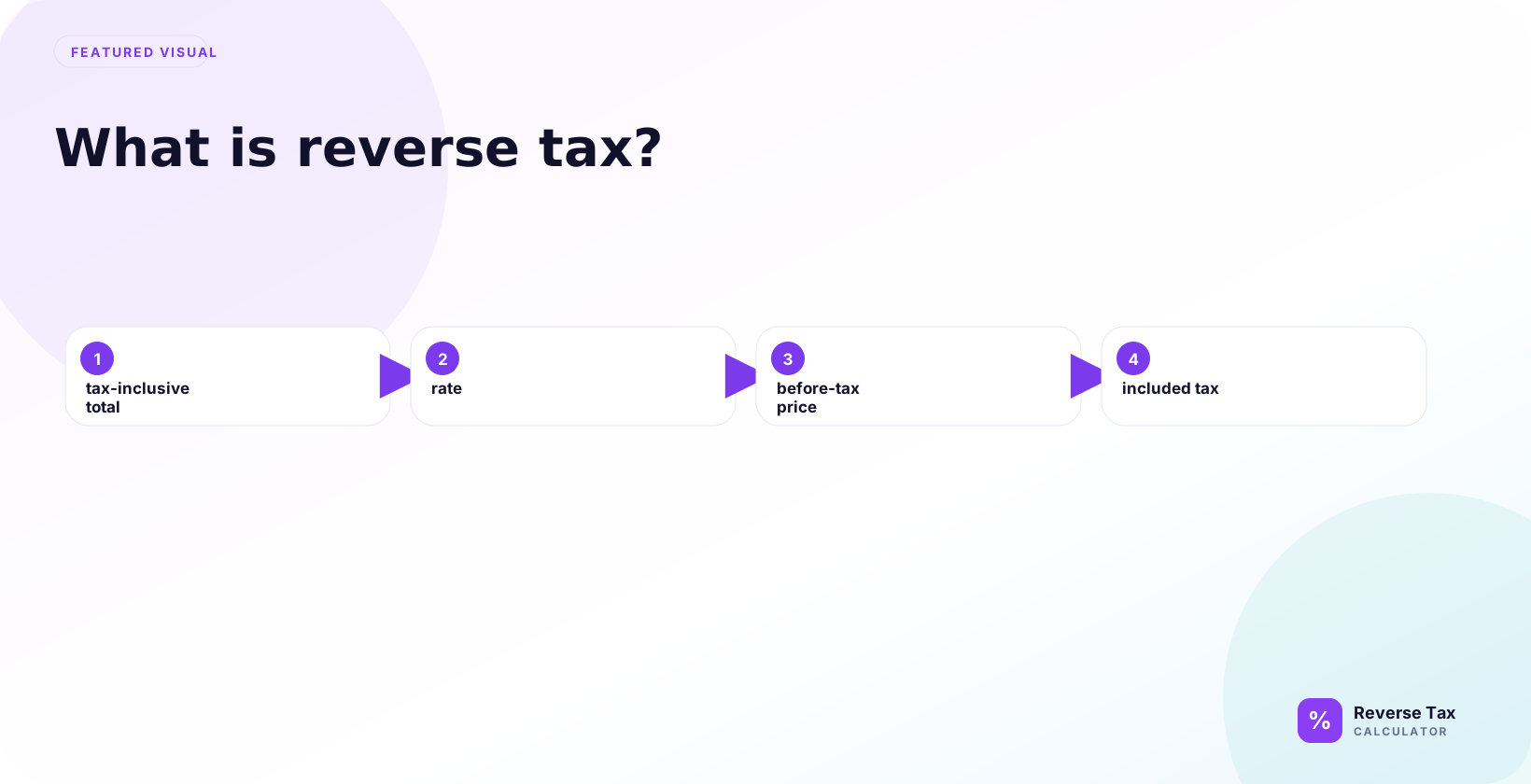
Reverse tax is the process of finding the price before tax and the included tax amount from a final tax-inclusive total. The calculation uses the tax rate to reverse the multiplier that created the final price: before-tax price equals total divided by 1 plus rate divided by 100. The answer is reliable when one rate applies to one taxable base; mixed rates, exemptions, discounts, shipping, and rounding need separate treatment.
For example, if a receipt total already includes sales tax, reverse tax helps you separate that total into two parts: the pre-tax price and the tax charged. This is useful when a receipt, invoice, gross sale, or tax-inclusive price does not clearly show the amount before tax.
If you already have a total and a tax rate, you can use a reverse tax calculator to find the pre-tax amount and included tax more quickly.
Reverse Tax Definition
Reverse tax means calculating backward from a final tax-inclusive amount to recover the amount before tax.
In a normal tax calculation, tax is added to a starting price. In a reverse tax calculation, the final price is already known, and the goal is to separate the tax from that final price.
The core idea is simple: the total price contains both the original price and the tax added to it.
Reverse tax is also called reverse sales tax, backward tax calculation, tax removal, or finding the price before tax. These terms are often used in similar situations, but they do not always mean the same thing in every tax system.
What Is the Meaning of Reverse Tax in Plain English?
The meaning of reverse tax is simple: you are reversing the direction of a tax calculation.
When tax is added normally, the calculation starts with the pre-tax price and ends with the final total. Reverse tax starts with the final total and works backward to the pre-tax price.
Think of it as unpacking a total. The final amount on a receipt may look like one number, but it often contains two parts: the seller's price and the tax added to that price. Reverse tax separates those parts.
This is why people may search for reverse tax, reverse taxes, tax reverse calculation, reverse calculate tax, or remove tax from total and mean nearly the same thing. The wording changes, but the core task is the same: take a tax-inclusive amount and find what was inside it before tax was included.
Reverse Tax as a Backward Calculation
Reverse tax is a backward calculation because the known number is at the end of the normal tax process.
In a normal tax calculation, the order is:
- Start with the pre-tax price.
- Apply the tax rate.
- Add the tax amount.
- Get the final total.
In a reverse tax calculation, the order is reversed:
- Start with the final total.
- Use the tax rate.
- Recover the pre-tax price.
- Find the included tax amount.
This is a calculation direction, not a special tax type.
Reverse Tax as Tax Removal
Reverse tax can also be described as removing tax from a total.
That phrase is useful for everyday users because it describes the result: the tax is separated from the total so the original price can be seen. However, "remove tax" should not be understood as deleting a legal tax obligation. It means removing the tax portion mathematically from a tax-inclusive number.
For example, removing tax from a receipt total does not mean the tax was not owed. It only shows how much of the final price was tax.
What Does Reverse Tax Calculate?
Reverse tax calculates the pre-tax amount and the tax amount hidden inside a tax-inclusive total.
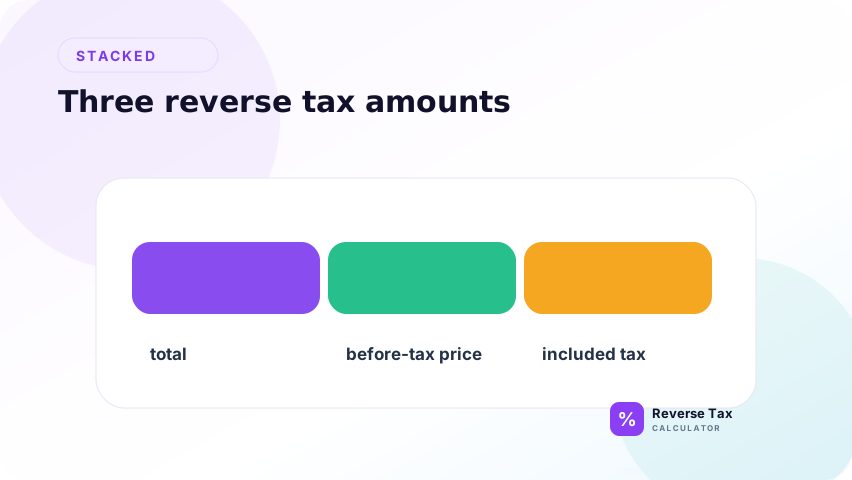
A tax-inclusive total is the final amount after tax has already been added. A pre-tax amount is the original price before tax. The included tax amount is the difference between those two numbers.
For a simple purchase, reverse tax answers questions like:
- What was the price before tax?
- How much tax was included in the total?
- Did the receipt or invoice separate tax correctly?
- What portion of a gross sale should be treated as revenue before tax?
Reverse tax does not decide which tax rate legally applies. The calculation only works as expected when the correct rate is used.
> Calculation accuracy note: this page explains the arithmetic relationship between a tax-inclusive total, a tax rate, a pre-tax price, and included tax. Jurisdiction-specific tax rates, exemptions, and filing rules must be checked separately. For site-wide calculation standards, see the methodology.
The Three Amounts in a Reverse Tax Calculation
Every basic reverse tax calculation depends on three connected amounts.
| Amount | Meaning | Example role |
|---|---|---|
| Tax-inclusive total | The final amount after tax is included | Receipt total |
| Pre-tax price | The amount before tax was added | Original item or service price |
| Included tax | The tax contained inside the total | Sales tax, VAT, GST, HST, PST, or QST amount |
The tax rate connects these amounts. If the tax rate is known, the total can be split into the pre-tax price and included tax.
If the tax rate is unknown, reverse tax becomes a different problem. You may need to find the rate on the receipt, check a trusted rate source, or use a separate rate-inference calculation.
Reverse Tax Entity Relationship
Reverse tax is easier to understand when the related entities are kept together.
| Entity | Relationship in reverse tax | What the user usually has or wants |
|---|---|---|
| Total price | Contains both pre-tax price and tax | User usually has this |
| Tax rate | Connects the total to the pre-tax price | User may know this or need to find it |
| Pre-tax price | Original amount before tax was added | User usually wants this |
| Included tax | Tax amount inside the final total | User usually wants this |
| Tax system | Sales tax, VAT, GST, HST, PST, QST, or similar | User may need this for rate context |
This relationship is the semantic core of reverse tax. If one part is missing or wrong, the result can become misleading.
Simple Reverse Tax Example
Suppose a receipt total is 110.00 and the tax rate is 10 percent.
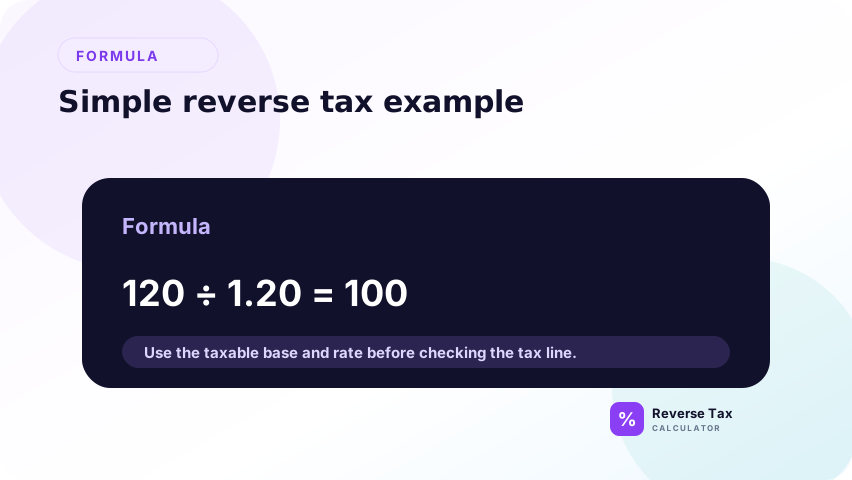
The 110.00 total is not made of 100.00 plus 10 percent of 110.00. It is made of a pre-tax price plus 10 percent of that pre-tax price.
In this simple case:
- Tax-inclusive total: 110.00
- Tax rate: 10 percent
- Pre-tax price: 100.00
- Included tax: 10.00
Reverse tax finds the 100.00 pre-tax price from the 110.00 total. Then it finds the 10.00 tax amount by comparing the total with the pre-tax price.
For the full equation and deeper calculation logic, use the reverse tax formula guide.
Is Reverse Tax the Same as Price Before Tax?
Reverse tax and price before tax are closely related, but they are not exactly the same phrase.
Reverse tax describes the calculation process. Price before tax describes one of the outputs of that process.
If you start with a tax-inclusive total and calculate backward, the price before tax is the amount you are trying to find. The included tax is the other output.
| Phrase | Focus | Example question |
|---|---|---|
| Reverse tax | The backward calculation | How do I reverse tax from this total? |
| Price before tax | The pre-tax result | What was the price before tax? |
| Included tax | The tax result | How much tax was in the total? |
| Tax-inclusive total | The starting amount | What part of this total was tax? |
This distinction matters because a page about reverse tax should explain the whole relationship, while a page about price before tax can focus more directly on the pre-tax amount.
Why Reverse Tax Is Not the Same as Subtracting the Tax Rate
Reverse tax is not the same as subtracting the tax percentage from the total.
This is the most common mistake. Tax is usually calculated on the pre-tax price, not on the final tax-inclusive total. When you subtract the tax percentage directly from the total, you treat the total as if it were the original tax base. That makes the result too low.
Here is the difference in plain language:
| Method | What it assumes | Result quality |
|---|---|---|
| Reverse tax | Tax was added to the original pre-tax amount | Correct for a simple tax-inclusive total when the rate is correct |
| Subtracting the percentage | Tax is a percentage of the final total | Usually wrong for sales tax, VAT, GST, and similar tax-inclusive calculations |
For example, if a 10 percent tax produced a 110.00 total, subtracting 10 percent from 110.00 gives 99.00. But the actual pre-tax price is 100.00.
The difference happens because 10 percent was added to 100.00, not taken from 110.00.
If you want the detailed explanation, read why subtracting the tax percentage is wrong.
When People Use Reverse Tax
People use reverse tax when the tax is already included in a price, receipt total, invoice total, refund, payout, or gross receipts report. Common use cases include finding pre-tax price, finding included sales tax, removing VAT or GST from a gross price, reconciling collected tax, checking receipts, and separating revenue from tax. The key is that the starting number already contains tax.
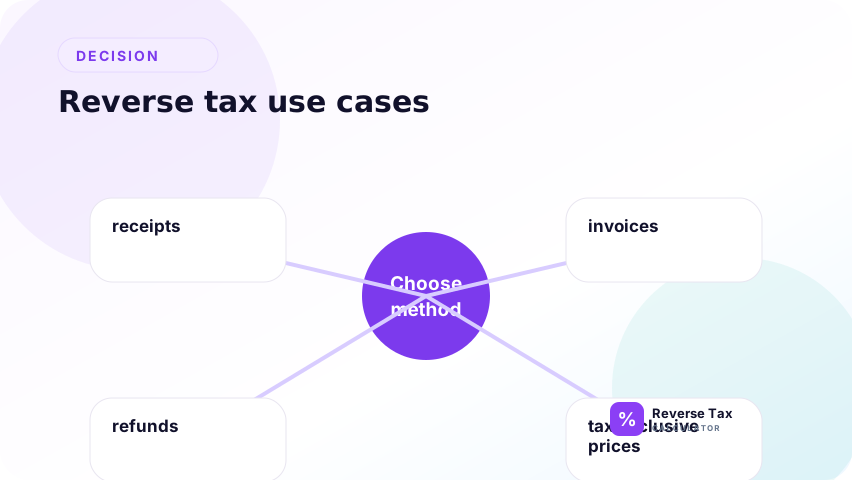
People use reverse tax when the final amount is known, but the pre-tax amount or included tax is unclear.
This happens often with receipts, invoices, tax-inclusive prices, accounting records, marketplace payouts, and business deposits. The calculation is small, but the context matters because the right tax rate and taxable base can change by location, item type, or tax system.
Receipts and Personal Purchases
Consumers use reverse tax to check what part of a receipt was tax and what part was the original price.
This is useful when a receipt shows only the final total, when an item was returned, or when someone wants to understand how much tax was included in a purchase.
If a receipt has multiple items, discounts, exempt items, or different tax rates, a simple reverse tax result may not match every line perfectly.
Invoices and Business Records
Businesses use reverse tax to separate tax from invoice totals, gross sales, or deposits.
A business may need to know how much of a tax-inclusive amount is revenue before tax and how much is collected tax. This matters for bookkeeping, reconciliation, and checking whether an invoice total is reasonable.
For business workflows, reverse tax is often only the first step. The result may need to be matched against invoices, receipts, refunds, and accounting categories.
Tax-Inclusive Prices
Reverse tax is useful when a price is shown with tax already included.
Tax-inclusive pricing is common in some VAT and GST contexts, and it may also appear in invoices, menus, quotes, ecommerce checkouts, or imported transaction data.
If a price is tax-exclusive, reverse tax is not the right first calculation. A regular forward tax calculation adds tax to a pre-tax price. A reverse calculation removes included tax from a final price.
Reverse Tax Across Sales Tax, VAT, GST, HST, PST, and QST
Reverse tax can describe the same backward calculation across different consumption tax systems.
The math is often similar when a simple percentage tax is included in a final total. The tax rules, tax names, rates, exemptions, and filing treatment can be very different.
| Tax term | Where the term is commonly seen | Reverse tax meaning |
|---|---|---|
| Sales tax | Often used in the United States and some other jurisdictions | Remove included sales tax from a final price |
| VAT | Value added tax systems | Remove included VAT from a tax-inclusive price |
| GST | Goods and services tax systems | Remove included GST from a total |
| HST | Harmonized sales tax in Canada | Remove included HST from a total |
| PST | Provincial sales tax in some Canadian provinces | Separate PST where it applies |
| QST | Quebec sales tax | Separate QST, often alongside GST |
this page defines reverse tax as a calculation concept. It does not set the rate for any jurisdiction. If you need a rate-specific guide, use the relevant rate or location page instead of guessing.
Why the Tax System Still Matters
The tax system matters because the correct rate and taxable base depend on rules outside the calculation itself.
A reverse tax calculation can be mathematically correct and still use the wrong rate. For example, the result may be wrong if the total includes exempt items, a local tax component, a special reduced rate, or multiple taxes applied in a specific order.
That is why reverse tax content should separate arithmetic from tax rules. The arithmetic explains how to split a total. The tax rules explain which rate and taxable base should be used.
Reverse Tax vs Similar Terms
Reverse tax can be confused with other tax terms because the phrase sounds broader than the calculation itself.
In this site, reverse tax means a backward calculation from a tax-inclusive total. It does not automatically mean a tax refund, a legal reversal of tax liability, or a reverse charge rule.
| Term | What it usually means | Same as reverse tax? |
|---|---|---|
| Reverse tax | Work backward from total to pre-tax amount and included tax | Yes, for this site |
| Reverse sales tax | Remove sales tax from a tax-inclusive total | Usually yes |
| Reverse charge | A VAT or GST mechanism where the buyer may account for tax | No |
| Tax refund | Money returned after tax was overpaid or adjusted | No |
| Tax reversal | A broad phrase that may refer to corrections, refunds, or accounting entries | Not always |
Reverse Tax vs Reverse Sales Tax
Reverse tax and reverse sales tax are often used for the same basic calculation.
Reverse sales tax is usually a narrower phrase. It often refers to removing sales tax from a final retail price. Reverse tax can describe the same backward calculation across sales tax, VAT, GST, HST, PST, QST, and similar consumption taxes.
The math is similar when the tax is a simple percentage added to the pre-tax amount. The tax rules and rate selection can differ by jurisdiction.
Reverse Tax vs Reverse Charge
Reverse tax is not the same as reverse charge.
Reverse tax is a calculation method. Reverse charge is a tax compliance mechanism used in some VAT and GST systems. In a reverse charge situation, the responsibility for accounting for tax may shift to the buyer rather than the seller.
Because these are different concepts, a reverse tax calculator should not be treated as a reverse charge compliance tool. For the distinction, see reverse charge vs reverse tax.
Reverse Tax vs Tax Refund
Reverse tax is not the same as a tax refund.
A tax refund involves getting money back because too much tax was paid, withheld, collected, or remitted. Reverse tax only separates a tax-inclusive number into pre-tax amount and included tax.
Reverse tax can help you understand the tax part of a transaction, but it does not prove that a refund is owed.
Common Reverse Tax Terms Explained
Reverse tax searches often use different wording for the same or nearby concepts. These terms should be understood clearly before using a calculator or reading a receipt.
| Term | Plain meaning | Belongs here? |
|---|---|---|
| Reverse tax | Working backward from a tax-inclusive total | Yes |
| Reverse taxes | Informal wording for reverse tax calculations | Yes, as a synonym |
| Reverse taxation | Broad phrase that may mean reverse tax or wider tax concepts | Yes, with clarification |
| Tax reverse calculation | Another way to describe calculating tax backward | Partly, but full steps belong to calculation guides |
| Reverse calculate tax | Informal wording for backward tax calculation | Partly, but full steps belong to calculation guides |
| Remove tax from total | Everyday wording for separating included tax | Yes, as a plain-language explanation |
| Price before tax | The pre-tax output of reverse tax | Related output |
| Tax-inclusive price | The starting price that already contains tax | Related input |
This table is useful because not every query uses the formal phrase "reverse tax." Searchers often describe the problem in the language of the number they have, such as total price, receipt total, tax included, or price before tax.
What This Page Does Not Calculate
This page explains the meaning of reverse tax. It does not perform every related calculation.
Use the calculator or a more specific guide when the task is more than a definition.
| If you need to... | Better next step |
|---|---|
| Calculate the result now | Use the reverse tax calculator |
| Learn the exact equation | Read the reverse tax formula |
| See step-by-step backward calculation | Read how to calculate tax backwards |
| Find tax from a known total | Read how to find the tax amount from a total |
| Understand receipt mismatch | Read about calculator results that do not match receipts |
| Choose the right rate | Read how to choose the correct tax rate |
This keeps the definition page focused while still helping users reach the right next page.
What Reverse Tax Can and Cannot Tell You
Reverse tax can tell you the pre-tax amount and the included tax amount when the final total and tax rate are known.
It can also help you check whether a simple receipt, invoice, or tax-inclusive price is mathematically consistent.
Reverse tax cannot confirm that the tax rate was legally correct. It cannot determine whether an item was taxable or exempt. It cannot replace tax advice, filing rules, or official rate verification.
Before relying on a reverse tax result, check these points:
- The total really includes tax.
- The tax rate is the correct rate for the location and tax type.
- All items in the total use the same rate.
- Exempt or zero-rated items are not mixed into the same calculation.
- Rounding differences may explain small one-cent differences.
If you are unsure which rate applies, start with how to choose the correct tax rate. If you already know the total and rate, use the reverse tax calculator to calculate the amount before tax.
Frequently Asked Questions About Reverse Tax
Reverse tax questions usually fall into a few intent groups: formula questions, receipt questions, VAT or GST questions, bookkeeping questions, rounding questions, and trust-boundary questions. A strong FAQ should answer the direct query, clarify when the formula applies, and warn when source evidence or official guidance is needed. The FAQ is not filler. It is a passage-level retrieval layer for long-tail search queries.
Is reverse tax the same as removing tax?
Reverse tax is often the same as removing tax from a tax-inclusive total. The goal is to find the price before tax and the amount of tax included in the final total.
Is reverse tax only for sales tax?
Reverse tax is not only for sales tax. The same backward calculation can apply to sales tax, VAT, GST, HST, PST, QST, and similar percentage-based consumption taxes when the correct rate and taxable base are known.
Can reverse tax tell me the correct tax rate?
Reverse tax usually needs the tax rate as an input. If you know the total and pre-tax amount, a separate implied-rate calculation can estimate the rate that was used, but it still does not prove that the rate was legally correct.
Why is my reverse tax result different from my receipt?
A reverse tax result may differ from a receipt because of rounding, mixed taxable and exempt items, multiple tax rates, discounts, shipping, tips, or an incorrect tax rate. Small one-cent differences are often caused by rounding rules.
What does tax reverse calculation mean?
Tax reverse calculation usually means working backward from a final total to find the original amount before tax and the tax included in that total. It is another way of describing reverse tax or calculating tax backwards.
Does reverse taxation mean the same thing as reverse tax?
Reverse taxation can mean reverse tax in casual search language, but it can also sound broader. On this site, reverse tax means a backward calculation from a tax-inclusive total, not a legal reversal of taxation.
Can I use reverse tax for VAT or GST?
You can use reverse tax for VAT or GST when the total includes a percentage-based VAT or GST amount and you know the correct rate. The calculation can separate the pre-tax amount from the included VAT or GST, but it does not confirm whether the rate or treatment is legally correct.
Related Reverse Tax Guides
To continue from this definition, these guides cover the next steps:
- How reverse tax works, for the mechanism behind the calculation.
- Reverse tax formula, for the exact equation.
- When to use a reverse tax calculator, for common situations and tool choice.
- How to calculate tax backwards, for a step-by-step calculation.
- Reverse tax calculation worked examples, for more examples with different totals and rates.