
Deductions, credits, and contributions change reverse income tax because each item changes the taxable income, tax due, or net pay used in the gross-up calculation. Deductions reduce taxable income, credits reduce tax, and payroll contributions reduce take-home pay after gross income is calculated. Accurate reverse income estimates require separating these effects instead of treating every payroll reduction as one flat tax percentage. Pre-tax and post-tax deductions affect different calculation points.
Why Adjustments Matter in Reverse Income Tax
Reverse income tax starts with a target net amount and works backward to gross income. Adjustments change the path between gross and net.
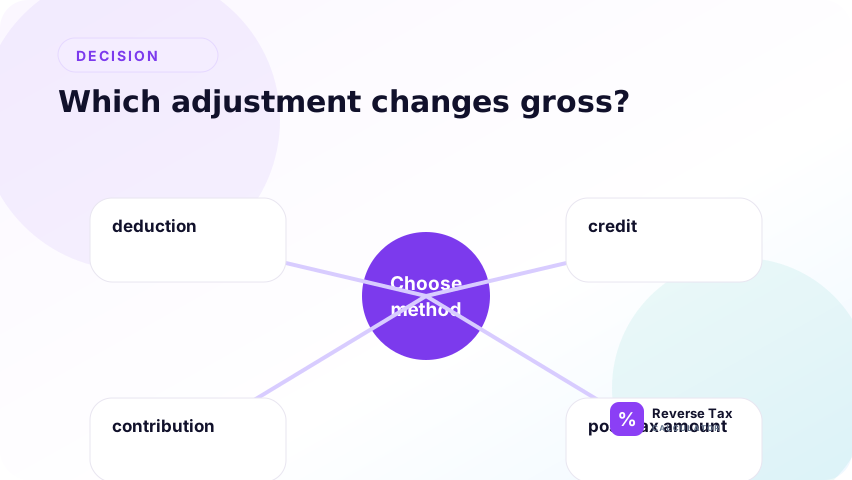
| Adjustment | Changes |
|---|---|
| Deduction | Taxable income |
| Credit | Tax after calculation |
| Pre-tax contribution | Taxable wages |
| Post-tax deduction | Final take-home pay |
| Employer benefit | May affect taxable or non-taxable compensation |
If an adjustment is ignored, the reverse calculation may hit the wrong net amount.
What Is a Deduction?
A deduction reduces taxable income. In a simple example, if gross income is 5,000 and a pre-tax deduction is 500, taxable income may be 4,500 before tax is calculated.
| Item | Amount |
|---|---|
| Gross income | 5,000 |
| Deduction | 500 |
| Taxable amount | 4,500 |
Deductions affect reverse income tax because the taxable base can be smaller than gross income.
What Is a Credit?
A credit reduces tax after the tax is calculated. It does not usually reduce taxable income directly.
Example:
| Step | Amount |
|---|---|
| Tax before credit | 1,000 |
| Credit | 200 |
| Tax after credit | 800 |
Credits can make net pay or final tax higher than a simple rate calculation would suggest.
What Is a Contribution?
A contribution is money paid into a plan or account. Some contributions are pre-tax and some are post-tax.
| Contribution type | Reverse-tax effect |
|---|---|
| Pre-tax retirement contribution | May reduce taxable wages |
| Roth or post-tax contribution | Reduces take-home pay after tax |
| Health plan deduction | May be pre-tax depending on plan |
| Employer contribution | May not reduce employee net pay |
The label alone is not enough. The tax treatment matters.
Pre-Tax vs Post-Tax Adjustments
Pre-tax adjustments happen before tax is calculated. Post-tax adjustments happen after tax is calculated.

| Adjustment type | Applied before tax? | Effect on net pay |
|---|---|---|
| Pre-tax deduction | Yes | Can reduce tax and net |
| Post-tax deduction | No | Reduces net after tax |
| Credit | After tax calculation | Reduces tax |
| Employer-paid benefit | Depends | May not reduce net |
This difference is critical in net-to-gross calculations.
Example: Pre-Tax Deduction
A pre-tax deduction changes reverse income tax because it reduces taxable income before tax is calculated. In a net-to-gross problem, the calculator may need to add back or solve around the deduction before estimating gross pay. Examples include some retirement contributions, benefit deductions, or other payroll items depending on jurisdiction and plan rules.
Suppose gross pay is 4,000, a pre-tax deduction is 500, and the tax rate is 20 percent.
Taxable pay:
4,000 - 500 = 3,500
Tax:
3,500 x 20 percent = 700
Net after deduction and tax:
4,000 - 500 - 700 = 2,800
The tax is based on 3,500, not 4,000.
Example: Post-Tax Deduction
A post-tax deduction happens after tax is calculated, so it does not reduce taxable income in the same way. In reverse income tax, a post-tax deduction means gross pay must cover both tax and the deduction. If a user enters only net pay, the calculator needs to know whether the deduction happened before or after tax to avoid understating gross income.
Suppose gross pay is 4,000, tax is 20 percent, and a post-tax deduction is 500.
Tax:
4,000 x 20 percent = 800
Net after tax:
4,000 - 800 = 3,200
Net after post-tax deduction:
3,200 - 500 = 2,700
The post-tax deduction does not reduce the taxable base in this simple example.
Example: Credit
A credit reduces tax directly, while a deduction reduces taxable income. This distinction matters in reverse income tax because a credit can reduce the gross income needed to reach a target net amount more directly than a deduction. Treating credits like deductions can produce the wrong gross estimate and the wrong tax bridge.
Suppose tax before credit is 1,000 and a credit reduces tax by 300.
Tax after credit:
1,000 - 300 = 700
If a reverse income tax calculator ignores the credit, it may overestimate the gross income needed to reach the same net amount.
Example: Net-to-Gross with Post-Tax Deduction
This example answers the query "why does a post-tax deduction increase gross needed?" If the employee must receive a target net amount after a post-tax deduction, gross pay must be high enough to cover tax first and then the deduction. The deduction is not reducing taxable income, so the reverse calculation has to solve for tax and deduction separately.
Target net:
3,000
Post-tax deduction:
200
Tax rate:
25 percent
Required after-tax pay before deduction:
3,000 + 200 = 3,200
Gross pay:
3,200 / 0.75 = 4,266.67
Tax:
4,266.67 x 25 percent = 1,066.67
After tax:
4,266.67 - 1,066.67 = 3,200
After post-tax deduction:
3,200 - 200 = 3,000
Example: Net-to-Gross with Pre-Tax Deduction
This example shows how a pre-tax deduction changes the taxable base before tax is calculated. The deduction may reduce taxable wages, which can reduce tax and change the gross needed to reach a target net pay. The calculator must know whether the deduction is a fixed amount or a percentage of gross because percentage deductions can require iteration.
Pre-tax deductions can require a different setup because the deduction changes taxable income.
Simplified structure:
Taxable pay = Gross pay - pre-tax deduction
Net pay = Gross pay - pre-tax deduction - tax
If the deduction amount is fixed, the formula may be rearranged. If the deduction is a percentage of pay, iteration may be easier.
Example: Percentage Contribution
Suppose an employee contributes 5 percent of gross pay before tax, and the tax rate is 20 percent. The desired net pay is 3,000.
If gross pay changes, the contribution changes too:
| Gross pay | 5 percent contribution |
|---|---|
| 3,500 | 175 |
| 4,000 | 200 |
| 4,500 | 225 |
Because the contribution depends on gross pay, a calculator may need to iterate until the net result matches the target.
Example: Credit Reduces Gross Needed
A credit can reduce the gross needed because it lowers tax directly. In reverse income tax, that means the same net target may require less gross income than a no-credit scenario. The effect depends on whether the credit is refundable, nonrefundable, fixed, phased out, or limited by tax liability. A simple calculator should label assumptions clearly.
Suppose a simple tax before credit would be 1,000, but a credit reduces tax by 200.
Tax after credit:
1,000 - 200 = 800
That lower tax can reduce the gross income needed to reach a net target. A reverse income tax calculation that ignores the credit may overestimate gross pay.
Why Contributions Can Require Iteration
Some contributions are percentages of gross pay.

Example:
| Contribution | Calculation basis |
|---|---|
| 5 percent retirement contribution | Gross pay |
| Health deduction | Fixed amount |
| Post-tax savings | Net or fixed amount |
If a contribution changes as gross pay changes, the reverse calculation may need iteration.
Pre-Tax and Post-Tax Decision Table
| Adjustment question | If yes | If no |
|---|---|---|
| Does it reduce taxable wages? | Treat as pre-tax | Check post-tax treatment |
| Does it reduce final net only? | Treat as post-tax | Check if employer-paid |
| Is it a percentage of gross? | Consider iteration | Fixed amount may be simpler |
| Does it reduce tax directly? | Treat as credit | Treat as deduction or contribution |
| Does it vary by pay period? | Convert periods first | Use fixed-period amount |
How IRS Withholding Tools Treat Inputs
The IRS Tax Withholding Estimator asks about income, deductions, adjustments, and credits. IRS Publication 15-T provides federal income tax withholding methods for payroll systems.
This supports a key rule: reverse income tax should not treat all employees as if one flat percentage explains the full paycheck.
| Input category | Why it matters |
|---|---|
| Income | Starting wage or salary |
| Deductions | Reduce taxable income |
| Credits | Reduce tax |
| Adjustments | Change tax calculation |
| Paystubs | Show actual withholding and deductions |
Decision Matrix
| Situation | Reverse calculation approach |
|---|---|
| No deductions or credits | Simple flat-rate estimate may work |
| Fixed post-tax deduction | Add deduction to net target first |
| Fixed pre-tax deduction | Adjust taxable base |
| Percentage contribution | Consider iteration |
| Tax credit applies | Reduce tax after calculation |
| Multiple jobs or credits | Use official estimator or tax professional |
Operational Workflow
Use this order:
- Start with gross pay or a gross estimate.
- Subtract pre-tax deductions and contributions.
- Calculate taxable wages.
- Apply tax rules or withholding method.
- Apply credits if relevant.
- Subtract post-tax deductions.
- Compare final net pay with the target.
- Adjust gross pay and repeat if needed.
The order matters because the same dollar can have different effects depending on when it is applied.
What Data Should You Collect First?
Before attempting a reverse income tax estimate, collect:
| Data | Why it matters |
|---|---|
| Current paystub | Shows actual deductions and withholding |
| Pay frequency | Aligns all amounts to the same period |
| Desired net amount | Sets the target |
| Pre-tax deductions | Changes taxable wages |
| Post-tax deductions | Changes final net |
| Contributions | May be fixed or percentage-based |
| Credits | Can reduce tax |
| Location | Adds state or local rules |
The IRS Tax Withholding Estimator asks for paystubs, income, deductions, adjustments, and credits because those inputs change withholding estimates.
How Adjustments Change Search Intent
Searchers often ask one simple question, but the hidden need differs.
| Search query style | Hidden calculation issue |
|---|---|
| gross pay from net pay | Need deductions and tax rate |
| salary after 401k contribution | Need pre-tax contribution treatment |
| paycheck after health insurance | Need deduction timing |
| net pay after tax credit | Need credit timing |
| bonus after deductions | Need supplemental pay and deduction rules |
This is why this page is not only a formula page. It is a classification guide for the inputs that make formulas work.
Why This Page Matters for Calculator Accuracy
A calculator that asks only for net pay and tax rate can explain the basic math. A calculator that wants a stronger payroll estimate must ask about deductions, credits, and contributions.
| Calculator input | Accuracy impact |
|---|---|
| Net pay only | Very weak |
| Net pay and rate | Basic estimate |
| Net pay, rate, and deductions | Better |
| Full payroll inputs | Strongest |
The best result comes from matching the calculator complexity to the user's accuracy need.
If the calculation is for payroll, benefits, or tax filing decisions, keep the source paystub and official withholding source with the estimate. That makes the number reviewable later with less audit confusion overall.
What This Calculation Can and Cannot Prove
| Can estimate | Cannot prove |
|---|---|
| Effect of a deduction on net pay | Eligibility for deduction |
| Effect of a credit on tax | Final annual tax liability |
| Gross needed under assumptions | Correct payroll setup |
| Difference between pre-tax and post-tax | Compliance treatment |
The math is only reliable when the adjustment type is correct.
Common Mistakes
Common mistakes include treating credits like deductions, assuming all contributions are pre-tax, ignoring percentage contributions, ignoring pay frequency, and using one flat rate for a complex paycheck. Income-tax reverse calculations are more sensitive than sales-tax reverse calculations because taxable income can change through many payroll and tax attributes.
The practical safeguard is to classify every adjustment before solving for gross income. Mark each item as pre-tax deduction, post-tax deduction, credit, fixed contribution, percentage contribution, withholding item, or non-tax payroll item. Then decide whether it changes taxable income, tax liability, or only net pay. Without that classification, even a detailed calculator can return a misleading gross estimate.
Treating Credits Like Deductions
Credits reduce tax. Deductions reduce taxable income.
Treating All Contributions as Pre-Tax
Some contributions are post-tax.
Ignoring Percentage Contributions
Percentage contributions change when gross pay changes.
Ignoring Pay Frequency
A monthly deduction and a biweekly paycheck need period conversion.
Using One Flat Rate for a Complex Paycheck
Flat-rate estimates can fail when credits, brackets, and deductions interact.
Entity Map for Income Tax Adjustments
| Entity | Role |
|---|---|
| Gross pay | Starting amount before deductions |
| Taxable income | Amount after pre-tax adjustments |
| Deduction | Reduces taxable income |
| Credit | Reduces tax |
| Contribution | May be pre-tax or post-tax |
| Net pay | Final take-home amount |
| Pay period | Aligns amounts |
| Withholding method | Applies official rules |
What This Page Does Not Cover
| Topic | Better page |
|---|---|
| Reverse income tax overview | What Is a Reverse Income Tax Calculator? |
| Net-to-gross salary | How to Calculate Gross Salary from Net Pay |
| Progressive tax brackets | Why Progressive Tax Makes Reverse Calculation Harder |
| Gross-up formula | Gross-Up Formula for Taxes |
Frequently Asked Questions
How do deductions affect reverse income tax?
Deductions can reduce taxable income, so the taxable base may be lower than gross pay.
How do credits affect reverse income tax?
Credits reduce tax after tax is calculated, so they can reduce the gross amount needed to reach a net target.
Are contributions pre-tax or post-tax?
It depends on the contribution type and plan rules. Classification must be verified before calculating.
Why do percentage contributions make reverse tax harder?
Because the contribution amount changes when gross pay changes.
Can a simple calculator handle all deductions and credits?
Only if it has the correct inputs and rules. Otherwise, use it as an estimate.
Sources
These sources support the income-tax and withholding context, while the examples on this page explain calculation logic. Use official tax authority tools and payroll guidance for jurisdiction-specific rules, deduction treatment, credit limits, contribution rules, and filing decisions. Use this page to understand why reverse income tax needs adjustment classification before estimating gross income.
- IRS, Tax Withholding Estimator
- IRS, Publication 15-T, Federal Income Tax Withholding Methods for use in 2026